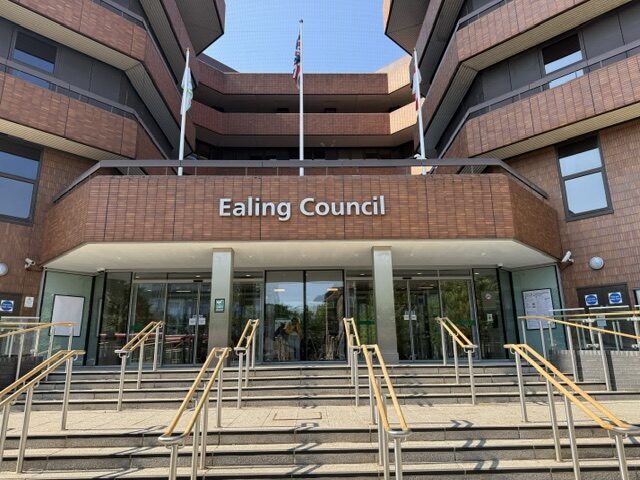
Ealing Council recorded more complaints and enquiries about adult social care with the Local Government and Social Care Ombudsman than any other London council last year, new figures show.
The Ombudsman received 54 complaints and enquiries concerning Labour-run Ealing Council in 2025/26 – ahead of Harrow, which had 40, Haringey with 36, Lewisham with 35 and Tower Hamlets with 33.
The figures cover the financial year from 1 April 2025 to 31 March 2026 and are contained in the Ombudsman’s annual review of adult social care complaints, published on Thursday (24 September 2026).
Ealing Council also had more complaints and enquiries than any of its neighbouring boroughs, with Brent and Hounslow each recording 31, Hammersmith & Fulham 20 and Hillingdon 17.
The Ombudsman figures are based on the total number of complaints and enquiries received and are not adjusted for population. Office for National Statistics estimates put Ealing’s population at around 386,000 in 2024, making it the third most populous London borough. The figures also do not take into account how many people use adult social care services in each borough.
Of the complaints about Ealing Council which went on to be investigated, 10 out of 12 were upheld – an uphold rate of 83.3%.
The 10 upheld complaints were the joint second-highest number among London councils, alongside Hackney. Only Haringey had more, with 11.
Ealing Council’s uphold rate was also higher than the 77% recorded nationally.
Only one of the 10 complaints upheld against Ealing Council had already been satisfactorily resolved by the council before the Ombudsman became involved.
The largest numbers of complaints and enquiries concerning Ealing Council were about assessments and care planning, and transport including Blue Badges, with 11 in each category. There were eight concerning charges and six involving safeguarding.
Among the cases upheld during the year was one involving a woman who was left without support to meet her needs following delays by Ealing Council.
In a decision issued on 7 November 2025, the Ombudsman found delays in assessing the woman’s care needs, producing a support plan and arranging an occupational therapy assessment.
She first requested a needs assessment in November 2022, but it was not completed until January 2024. Ealing Council agreed to apologise, complete her support plan, make a payment and issue guidance to officers.
Another case involved a woman who is registered blind and waited nine months for an occupational therapy assessment.
In a decision issued on 20 November 2025, the Ombudsman found Ealing Council at fault over the delay and for failing to keep the woman properly informed while she waited.
Ealing Council agreed to apologise, pay her £250 and introduce a clearer process for keeping people waiting for occupational therapy assessments updated.
A third upheld complaint concerned delays in assessing how much a woman should contribute towards her care-home costs.
In a decision issued on 30 September 2025, the Ombudsman found Ealing Council arranged the residential care in February 2024 but did not carry out a financial assessment until the following year.
An initial invoice for more than £11,000 was subsequently reduced, leaving £8,740 outstanding. Ealing Council agreed to apologise, reduce the outstanding care costs by £500, offer an affordable repayment plan and remind staff that financial assessments should be arranged when care is set up or as soon as possible afterwards.
Ealing Council complied with all the Ombudsman recommendations recorded as due for completion during the year, giving it a 100% compliance rate.
Speaking to EALING.NEWS about the Ombudsman’s annual review, an Ealing Council spokesperson said: “We have made numerous changes following the Ombudsman’s recommendations including being far more proactive and providing additional guidance to our officers on statutory duties. The Ombudsman noted we complied with 100% of their recommendations in these cases.
“Ealing is the third most populous borough in London, with around 45% more residents than either Hackney or Haringey, so comparisons based solely on the total number of complaints do not take account of the significant differences in populations.
“The number of complaints needs to be seen alongside the more than 5,000 people who receive adult social care support in the borough of Ealing, but every upheld complaint matters. We want to identify and resolve problems as early as possible, learn from care users’ experiences and reduce the issues ever happening again.”
They added: “We recognise that there is still work to do to ensure all residents receive a consistently high level of service and are committed to acting on feedback. We are working hard to ensure our services continue to improve so we deliver the very best experiences for all our service users.”
Councillor Gary Malcolm, leader of the Ealing Liberal Democrats, told EALING.NEWS: “Liberal Democrats say that Labour-run Ealing Council is terrible how it treats many vulnerable residents. Time after time they are left needing help but just ignored. Shame on Labour.”
Councillor Clare Welsby, leader of the Green Group, told EALING.NEWS: “It is very worrying to hear that complaints about adult social care have risen by 22% annually across England, with 54 complaints to Ealing Council during the year – the highest number of any London council. We need to ask why this is happening.
“Care commissioners and providers must examine the reasons why and act on lessons learned. There seems to be a pattern in Ealing of unresolved complaints leading to intervention by the Ombudsman who in most cases upholds the original complaint.
“Of the 12 complaints investigated, 10 were upheld – an uphold rate of 83.3%. This leads to unnecessary delays, which place even more pressure on individuals and their families whose needs have not been properly met, and trust and relationships with services break down, benefiting no one.
“Listening and learning when things go wrong and working to resolve difficulties at an early stage benefits all concerned.”
Across England, the Ombudsman received 3,938 complaints and enquiries about adult social care in 2025/26, an increase of 22% on the previous year.
It investigated 904 cases nationally and upheld 77% of them.
Local Government and Social Care Ombudsman Amerdeep Clarke said: “We are seeing welcome signs of improvement in how councils and care providers handle complaints, but there is still more to be done.
“My message to the sector is simple: use the learning in this report to improve services now, rather than waiting for wider changes to the care system that are currently under discussion.”
She added: “Behind every one of these numbers is a person, a family or a carer trying to get things back on track after something has gone wrong.”

