

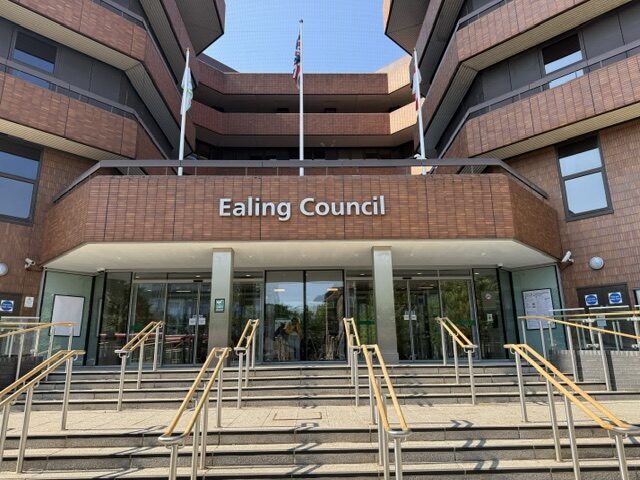
A new Housing Ombudsman report has revealed that complaints about Labour-run Ealing Council’s housing service reached the watchdog at more than three times the rate recorded among landlords of a similar size and type.
The Ombudsman received 243 cases concerning Ealing Council from 1 April 2025 to 31 March 2026 — equivalent to 15.8 for every 1,000 council homes.
That compares with a median of 5.2 cases per 1,000 homes among landlords of a similar size and type.
The report was published on Tuesday (15 September 2026) as part of the Housing Ombudsman’s Annual Complaints Review of landlords for 2025–26.
Ealing Liberal Democrat leader Councillor Gary Malcolm told EALING.NEWS the council had “again been shown to be failing”, while Ealing Green Group leader Clare Welsby said the figures indicated “local failure” and Ealing Conservatives leader Councillor Julian Gallant described levels of maladministration as “far too high and increasing”.
Councillor Malcolm said there were “too many cases where residents have been treated badly”, while Councillor Welsby said she was “shocked” that maladministration had been found in 88% of findings concerning Ealing Council.
Ealing Council’s 88% maladministration rate compares with 62% nationally and 70% among landlords of a similar size and type. It was up from 82% in 2024–25 but remained just below the 89% recorded in 2023–24.
Ealing Council also recorded 4.7 maladministration findings for every 1,000 homes, almost two and a half times the comparable median of 1.9.
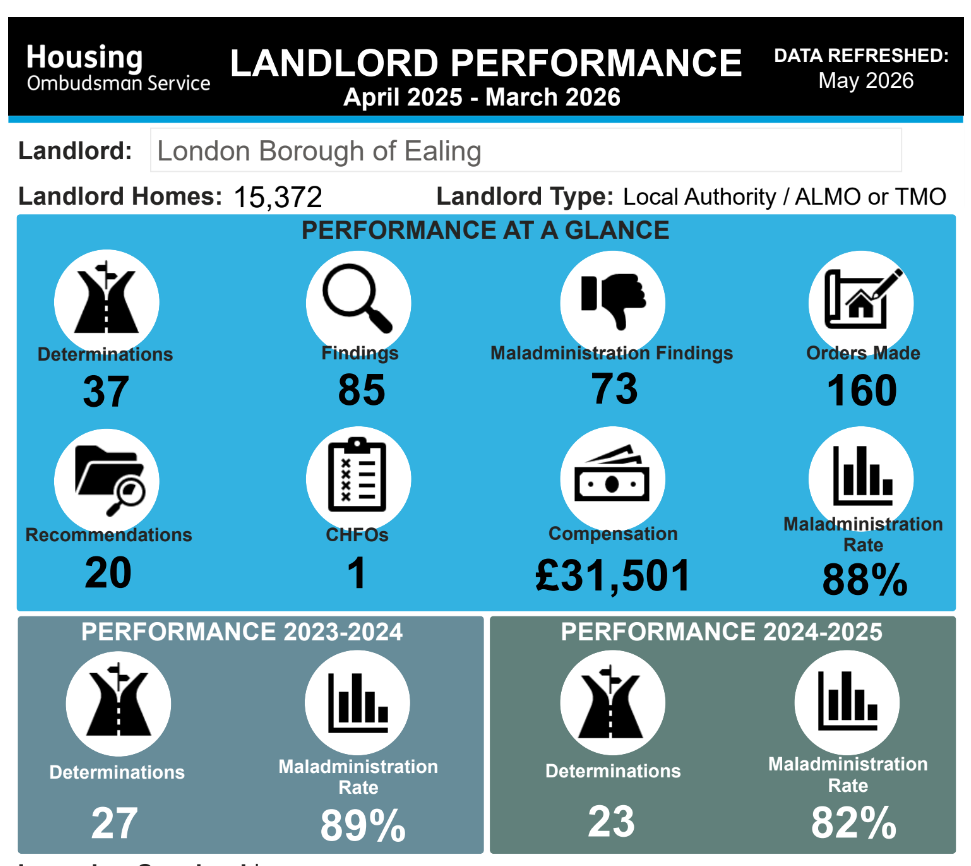
The report covers Ealing Council’s housing service from 1 April 2025 to 31 March 2026 and is based on a housing stock of 15,372 homes.
The 243 figure covers cases received during the year, rather than cases investigated and decided within the same period. Complaints can continue across reporting years.
During 2025–26, 44 cases involving Ealing Council were concluded by the Housing Ombudsman. Seven were withdrawn or found to be entirely outside its jurisdiction, leaving 37 determinations that formed the basis of the council’s performance figures.
As individual cases can cover more than one issue — such as the repair itself and the way a subsequent complaint was handled — those 37 cases resulted in 85 separate findings.
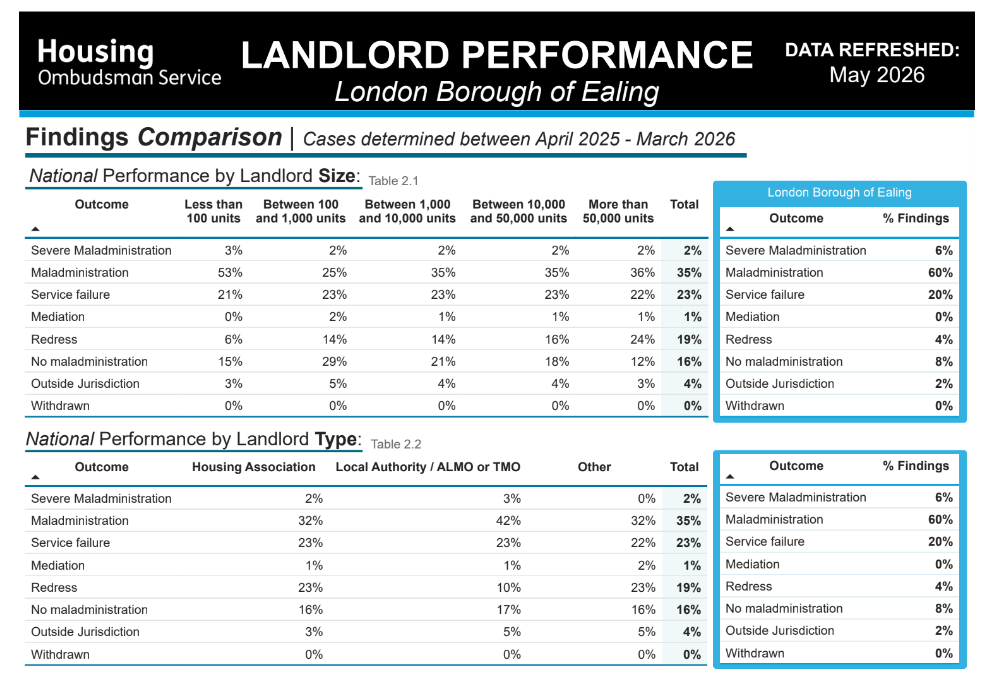
Two findings fell outside the Ombudsman’s jurisdiction. Of the remaining 83, 73 were upheld: five findings of severe maladministration, 51 of maladministration and 17 of service failure.
Seven findings found no maladministration, while in three the Ombudsman concluded that Ealing Council had already provided reasonable redress.
Repairs were the most serious area of concern at Ealing Council.
The Ombudsman found maladministration in 95% of its responsive repairs findings, compared with a national rate of 72%.
All five severe maladministration findings involving Ealing Council concerned responsive repairs. These arose from cases involving damp and mould and leaks.
Severe maladministration is the Ombudsman’s most serious finding and means a landlord’s failure has had a significant impact on a resident.
There were 15 findings concerning damp and mould, including two findings of severe maladministration and 12 of maladministration. One finding was outside the Ombudsman’s jurisdiction.
All 10 findings concerning leaks were upheld, including three findings of severe maladministration and seven of maladministration.
The report also raises concerns about the council’s dealings with residents and its handling of complaints.
It recorded 35 findings under “managing relations”, with maladministration found in 89% of those findings. The national rate for the same category was 57%.
There were also 32 complaint-handling findings and the Ombudsman issued one Complaint Handling Failure Order against Ealing Council.
Such orders are issued when a landlord has failed to meet the requirements of the statutory Complaint Handling Code during the complaints process.
The Ombudsman changed its approach during 2025–26 and now considers complaint handling in every case it fully investigates, rather than only where the resident has specifically complained about it.
That change affects direct comparisons with previous years, although the Ombudsman said the national maladministration rate would still have fallen without it.
The report lists £31,501 in compensation concerning Ealing Council, comprising £31,436 ordered by the Ombudsman and a further £65 recommended.
More than £25,000 of the compensation related to responsive repairs.
The Ombudsman issued 160 orders to Ealing Council, including 70 compensation orders, 40 apologies and 24 orders requiring repairs. It also required specific actions, case reviews, a policy review and staff training.
According to the report, Ealing Council complied with all the orders within three months.
Councillor Malcolm said: “Liberal Democrats say that Labour-run Ealing Council has again been shown to be failing.
“There are too many cases where residents have been treated badly, too many cases where the council has either failed to act or has acted badly, and too many times when Labour-run Ealing Council has had to pay out large sums in compensation.
“If Ealing Council were a football team, it would have been relegated many times over, but sadly the manager still seems to be in place. Many people are asking why?”
Councillor Welsby said the findings did not surprise her after hearing from council tenants and leaseholders about their experiences of requesting repairs.
She said: “However, I am shocked at the level of maladministration in 88% of its findings concerning Ealing Council, rising from 82% in 2024–25, compared with 62% nationally and 70% for landlords of a similar size and type.
“None of these figures is good, and Ealing Council’s figure is the worst of the three, indicating additional local failure within a system that is not working far more widely.
“To maintain existing social housing and build more, central government needs to provide more funding to local authorities and re-evaluate the market model for housing.”
Green Party councillor for South Acton, Councillor Husam Alharahsheh, said the figures highlighted the importance of maintaining existing council homes as well as building new ones.
He said: “Housing remains one of the most important issues facing residents across Ealing. As our borough continues to grow, we need more homes, particularly genuinely affordable homes that allow people to remain in the communities they love.
“But housing policy cannot be judged solely by the number of units delivered. We must also consider the quality of housing, the condition of existing homes and the experience of the residents living in them.
“Recent figures from the Housing Ombudsman highlight ongoing challenges around repairs, damp and mould, and landlord-resident relations.
“Ealing Council recorded an 88% maladministration rate in Ombudsman findings, with particularly high levels relating to responsive repairs and resident interactions.
“These figures remind us that building new homes and maintaining existing homes are equally important responsibilities. As Ealing grows, we must ensure that investment in housing is matched by investment in quality, maintenance and resident services.”
Councillor Gallant told EALING.NEWS: “The 2025-2026 Housing Ombudsman Report isn’t exactly bedside reading but it should be keeping Labour wide awake. Levels of maladministration in dealing with maintenance complaints by social housing tenants are far too high and increasing. A council that prioritises transparency needs to show how improvements will be made, as from now.”
EALING.NEWS put six questions to Ealing Council, asking it to explain why its maladministration rate was 88% and why 243 cases reached the Ombudsman; what went wrong in its repairs and complaint handling; what action was being taken; whether all compensation had been paid and the Ombudsman’s orders completed; and whether it accepted that the findings showed systemic problems rather than isolated failings.
Responding to the findings, an Ealing Council spokesperson said the council had carried out a comprehensive review of its housing services and made “significant progress” during the past 12 months, while acknowledging that more work remained.
The spokesperson told EALING.NEWS: “Ealing Council is committed to providing safe, high-quality homes and services for our tenants.
“We have undertaken a comprehensive review of our housing services to understand the issues and ensure the necessary improvements are delivered and sustained. We are focused on strengthening our governance, data systems, capacity, service delivery and accountability.
“A good example is how we are now dealing with complaints, which is part of our housing improvement plan, where we have consulted with residents and are now publishing quarterly updates on our progress to ensure we are both transparent about the work we are doing and accountable for its delivery.
“There are a number of areas where we are performing strongly, including our understanding of the condition of our homes, improvements in compliance and repairs performance, and our compliance with the Neighbourhood and Community and Tenancy Standards. While there were areas requiring improvement, we were delivering a range of services effectively and had positive foundations on which to build.
“The information in the Ombudsman report is from a while ago and we have made significant progress over the last 12 months, particularly with how we have performed in complying with Awaab’s Law. However, we are aware there is still more work to do and we are not complacent. Our focus is on embedding improvements into day-to-day operations, strengthening resident engagement and continuing to improve services. Our ambition is to surpass the highest regulatory standards. Our priority is delivering lasting improvements that give tenants confidence in the safety and quality of the homes and services we provide.”
While the council outlined the improvements it said were being made, its response to EALING.NEWS did not directly explain the high case and maladministration rates or say whether it accepted that the findings indicated systemic problems.

