


Ealing Council has been criticised for its failures in the latest Severe Maladministration report from the Housing Ombudsman, published last week (28 October 2025), which highlights serious and long-running shortcomings caused to tenants by social landlords in tackling damp, mould and other housing hazards.
The Labour-run council was among 24 landlords found at fault for poor complaint handling and delayed action once problems had been reported. The Ombudsman ruled that Ealing Council had committed severe maladministration after a resident with chronic obstructive pulmonary disease (COPD) suffered long-running damp and mould in her home that went unresolved for more than a year.
According to the report, the resident first complained that mould was spreading throughout her home, forcing her to stop using the kitchen because of the smell and unhealthy conditions. Despite her long-term illness and repeated requests for help, Ealing Council took five months to respond. When it eventually did, officers arranged visits but failed to identify or tackle the root cause of the damp, and no repairs were completed.
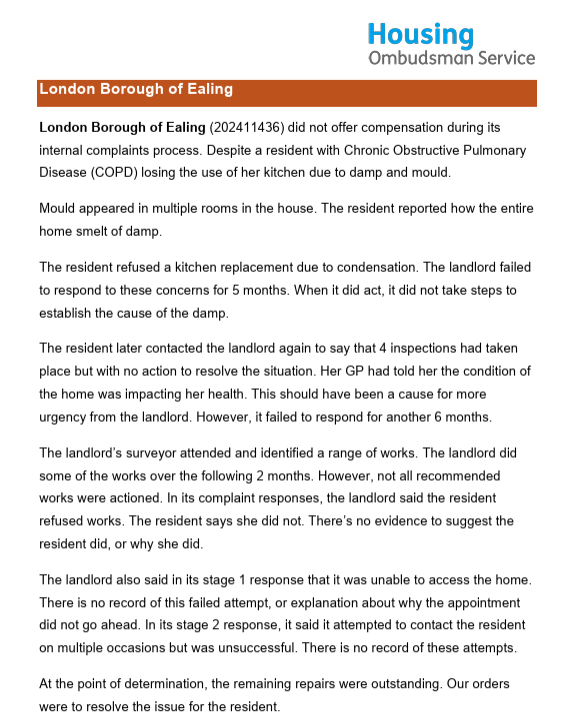
Over the following months, the resident contacted the council again as the mould continued to spread, and four separate inspections took place. Yet despite those visits, no lasting action was taken, leaving the property in the same condition and the tenant still living in unhealthy surroundings.
Her GP wrote to the landlord warning that the housing conditions were worsening her health, but the council took a further six months to respond.
A surveyor was eventually sent and identified a list of necessary works, but several were not done. The council later claimed the resident had refused some of the repairs, which she denied. The Ombudsman said there was no record kept of the alleged refusal or of any follow-up contact. In a subsequent visit, when the landlord again said it had been unable to gain access, there was still no record kept of the attempt or of any further communication with the tenant.
By the time the Ombudsman reached its decision, parts of the home were still in disrepair. The watchdog said Ealing’s handling of the case showed “a failure to act with urgency and coordination” and ordered it to complete the works, apologise to the resident and review its procedures to prevent similar failings.
The Housing Ombudsman defines severe maladministration as a finding made when a landlord has failed significantly in its duties, showing serious service failure that has caused residents harm, distress or disadvantage. It is the Ombudsman’s strongest level of finding, reserved for cases where a landlord’s conduct — or lack of action — has had a serious and lasting impact on tenants.
The case forms part of a broader set of investigations published in the Ombudsman’s Learning from Severe Maladministration series, which analyses systemic weaknesses across the social-housing sector. The October report was the first since Awaab’s Law came into force on 27 October 2025, setting statutory deadlines for landlords to investigate and repair hazards such as damp and mould.
The law is named after two-year-old Awaab Ishak, who died in 2020 from respiratory failure caused by prolonged exposure to mould in his family’s housing-association flat in Rochdale. His death prompted a national outcry over housing standards and the speed at which social landlords respond to health-related hazards.
Housing Ombudsman Richard Blakeway said: “This report reinforces the need for Awaab’s Law. The issues in these cases take months or even years to be addressed and in some cases are unresolved until we intervene. This is far from action happening within days or weeks, as would be expected now under Awaab’s Law.”
Mr Blakeway added: “Landlords should not lose sight of other requirements, such as effective inspections, providing suitable temporary moves and clear, empathetic communication. There is a risk of false assurance if governing bodies focus only on the tangible targets.
“Sharing insights and sector collaboration will help landlords during the initial months practising Awaab’s Law. This collective effort will make residents’ homes safer.”
Speaking to EALING.NEWS about the report, Councillor Jon Ball, Ealing Liberal Democrats housing spokesperson, said: “It is shocking but sadly not surprising to see Ealing Council highlighted once more by the Housing Ombudsman as committing severe maladministration. In the case referred to it failed to successfully deal with damp and mould in over a year despite it making the tenant’s health problems worse. Sadly we as opposition councillors regularly see cases like this where Labour-controlled Ealing Council continues to let its tenants down over and over again.”
An Ealing Council spokesperson told EALING.NEWS: “Keeping our residents safe in their homes is a top priority for us. We take all complaints seriously, and we are truly sorry that this tenant had to live in these conditions. We regret the poor service and communication the tenant experienced, the prolonged handling of repairs, and the delays in resolving the damp and mould affecting their home.
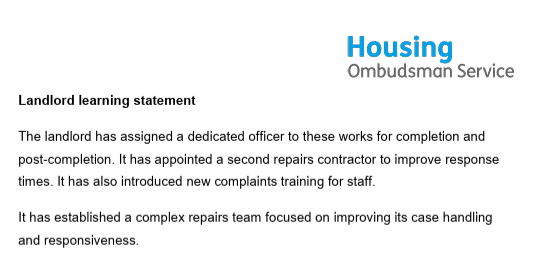
“We are working with our contractors to complete the outstanding works at the tenant’s home and have assigned a dedicated officer to the case, who will oversee the project until the home is once again in the right condition.
“We are committed to continuously improving our services. In response to this case, we have made a series of changes. We have appointed a second repairs contractor to help improve our response times. We have a new complaints approach and policy to ensure we listen to our residents and deal with their issues promptly and properly, and we have upgraded our complaints training for colleagues. We have also established a complex repairs team which focuses on improving our case handling and responsiveness. We now better manage damp and mould cases like this, and we will continue working hard to deliver the quality homes and services that our tenants expect from us.”

