

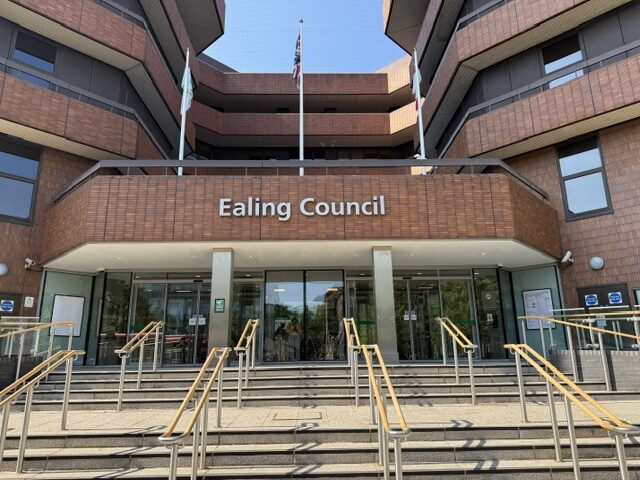
Ealing Council has warned that “an increasing number” of homeless residents and families are likely to be placed in temporary accommodation outside the borough because of a shortage of affordable housing locally and rising rents.
The warning comes as the council prepares to introduce a new placement policy which could see some homeless residents offered accommodation more than 90 minutes from Ealing, including outside London.
The proposals are due to go before Labour-run Ealing Council’s cabinet on Wednesday (7 October 2026), where Labour councillors will be asked to approve the new policy.
Ealing Council already places homeless residents outside the borough, but the new policy would introduce a three-zone system setting out who should receive priority for scarce accommodation in or closer to Ealing.
The system would determine which residents get priority for accommodation in Ealing, who gets priority to stay within 90 minutes of the borough and who could be offered somewhere further away.
The policy says: “The aspiration remains to place all households in accommodation in the borough. However, where there is insufficient accommodation to meet demand on any given day, the criteria set out below will be used to prioritise allocation.”
Those who do not qualify for either of the first two zones could be offered accommodation more than 90 minutes from Ealing, with the third zone covering “any area including outside of London”.
The plans come as more homeless residents are increasingly being placed outside Ealing than within the borough.
Between the first and third quarters of 2025/26, the number of in-borough placements increased from 133 to 180, while those outside the borough rose from 323 to 375. Out-of-borough placements were higher in every quarter.
The council says keeping all placements within Ealing would not be achievable in practice and could reduce its ability to meet its legal duties towards homeless residents and families.
It also says “the demand for housing greatly exceeds supply”, with high rents and affordability making it harder to find private rented and temporary accommodation within Ealing.
Under Zone 1, priority for accommodation in Ealing would be given to households with a child who has an Education, Health and Care Plan (EHCP) and attends a specialist educational setting in the borough.
It would also cover households where someone has a severe and enduring physical condition requiring intensive specialist medical treatment only available in Ealing, or receives a significant council or NHS care package which cannot be transferred elsewhere.
Being in Zone 1 would not guarantee a home in Ealing. If suitable and affordable accommodation was not available, the council says an offer would be made as close to the borough as possible.
Zone 2 would give other groups priority for accommodation within 90 minutes of Ealing by public transport.
They include households where someone has been continuously employed for at least six months and works 16 hours or more a week, as well as women on maternity leave who met those employment requirements before going on leave.
Families with children due to take GCSEs, AS or A Levels, BTECs or equivalent exams would also be included, along with households with a child subject to a Child Protection Plan and some families being helped by Children’s Services.
Ealing care-experienced young adults under 25 who have an assigned personal assistant would also qualify for Zone 2.
Being in Zone 2 would not guarantee accommodation within 90 minutes if a suitable and affordable property was unavailable.
For households which do not qualify for either of the first two zones, the policy says: “Applicants who do not meet any of the criteria set out for Zones 1 or 2 will be offered properties further afield than 90 minutes travelling distance of the London Borough of Ealing by public transport.”
The council argues that moving further away could, in some cases, make housing more affordable.
Its policy says: “In many cases housing outside of the borough will be more sustainable for the household in the long term, with lower rents allowing them to better meet their subsistence and household costs and avoid rent arrears.”
The council’s documents also reveal concerns that moving residents and families outside Ealing could lead to “disruption to education, healthcare and care arrangements, loss of support networks, increased travel times and costs, and social isolation”.
The new policy is intended to make it clearer how decisions about where residents are placed are made and to “improve outcomes for residents experiencing homelessness”.
Decisions would still be made on a case-by-case basis, taking into account each household’s circumstances.
Residents unhappy with where they have been placed would be able to ask Ealing Council to review its decision. If the council finds in their favour, it would make them another offer of accommodation.
If they were still unhappy after the review, they could appeal to the County Court, but only on the basis that the council had made a legal error. They would have 21 days from being notified of the review decision to appeal.

