
Ealing Council has collected more than £11 million from residential parking permits since 2020, according to new data obtained via a Freedom of Information (FOI) request.
The figures show a 137% increase in revenue over five years, driven by rising permit costs and a shift to emissions-based pricing.
The council says that “any revenue generated is reinvested to support transport improvements and sustainability initiatives that benefit all”.
Revenue by year:
- 2020: £1,240,722.99
- 2021: £2,098,249.60 (+69.1%)
- 2022: £2,369,867.93 (+12.9%)
- 2023: £2,687,338.99 (+13.4%)
- 2024: £2,935,810.00 (+9.3%)
The FOI request by cinch also revealed that the number of permits issued has climbed steadily. According to Ealing Council’s own records, 106,830 residential parking permits were issued between 2020 and 2024 which made a total of £11.33m.
Permit numbers rising:
- 2020: 11,362
- 2021: 20,661 (+81.9%)
- 2022: 23,625 (+14.3%)
- 2023: 25,356 (+7.3%)
- 2024: 25,826 (+1.9%)
At the current rate, Ealing is on track to generate over £3 million from permit sales in 2025, setting a new record.
Sam Sheehan, motoring editor at cinch, said: “Parking permits can be great for making sure residents have somewhere to park near their homes, but there should be a balance between affordability and accessibility.
“Our research shows that parking permits are getting more expensive across the UK, putting extra financial strain on residents already dealing with rising living costs. Multi-car households are often the most affected. Second and third permits come at a premium and can be as much as four times more expensive than a first permit in some areas.”
Speaking to EALING.NEWS, an Ealing Council spokesperson said:
“Revenue from residential parking permits in borough of Ealing has seen a gradual increase over the past five years. This reflects changes in permit pricing to better align with environmental policy, as well as inflationary adjustments. The introduction of a more comprehensive emissions-based pricing model has been a key part of our strategy to promote lower-emission vehicle use across the borough.
“Any revenue generated is reinvested to support transport improvements and sustainability initiatives that benefit all. It’s important to note that the increase between 2020 and 2021 was largely due to Covid measures. Essential workers had their permit charges waived and permits were refunded.”
On the impact of price increases and band emissions pricing, the spokesperson added:
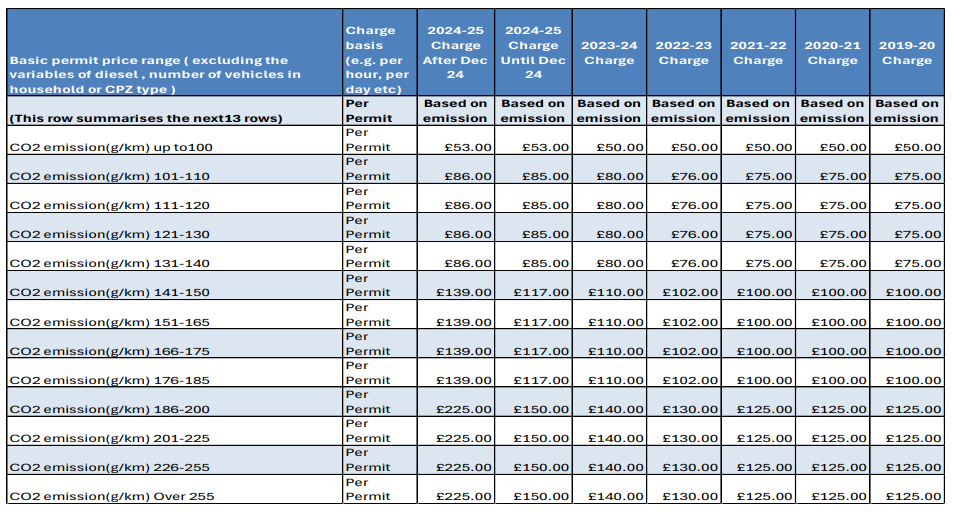
“Yes, much of the revenue growth is related to changes in the permit pricing model, as well as inflationary adjustments. In 2025, the council replaced the previous model with a 13-band emissions-based pricing system which more accurately reflects the impact of high emission vehicles and rewards the use of lower emission vehicles.
“This approach is designed to encourage residents to transition to cleaner vehicles by aligning permit costs with environmental impact. This approach was also adopted to align with industry agreed standards.”
On transport behavioural changes and how parking permit revenue is reinvested by the council, they said:
“While we should see an upward trend in revenue over time this will depend on behavioural changes such as uptake in the use of public transport and more people cycling, as well as permit uptake with drivers responding to ULEZ and an increase in residents shifting to lower emission vehicles, which could result in a net fall in income (one high emission and high cost vehicle if replaced by one lower emission and lower cost vehicle will see a net fall in revenue per vehicle).
“Any surplus from residential parking permits is reinvested directly into local transport and road infrastructure improvements, including street maintenance, public transport support, and active travel schemes.”
The council also shared a cost comparison:
- In 2020, a standard residential permit for a car emitting 101–110g CO₂/km typically cost £85.
- In 2025, the same vehicle would cost around £120.
- Zero-emission vehicles pay £50, while high-emission vehicles (over 255g CO₂/km) can be charged up to £340.
- Diesel vehicles built before 2015 face a £55 surcharge, and additional household vehicles incur a £60 fee each.
On future price increases, Ealing Council stated:
“Permit pricing is reviewed annually, and any future changes would be considered as part of the council’s wider strategy to support sustainable travel, reduce emissions, and improve air quality. At present, no specific increases have been confirmed, but our approach remains guided by environmental goals and fairness to residents. Any changes would be subject to formal review, modelling, and – where appropriate – public consultation.”

 request.)